

Islamabad, October 19, 2026: Rifts inside the Pakistan Tehreek-e-Insaf (PTI) have come into the open after a meeting of the party’s core committee, where members reportedly demanded an inquiry into how the talks with the government collapsed and what followed. Accounts of the outcome differ.
What happened at the meeting
According to the Urdu report, members criticised the party leadership and asked for a fact-finding committee covering everything from the date of the long march to the imposition of the emergency. They reportedly said they had not been told about many of the meetings and that things had been kept from them. They wanted the committee to decide who was responsible for the failure of the talks. Sources cited in the report say PTI Chairman Barrister Gohar Ali Khan refused to form such a committee.
A separate report in The Express Tribune, citing sources, says the party’s core and political committees met on Sunday and did constitute a fact-finding committee, but to investigate why the long march failed. Per that report, the meeting was held after the removal of the party’s provincial government in Khyber Pakhtunkhwa (K-P) on October 11, to review the governor’s rule and emergency and discuss future strategy. The two accounts conflict, and I could not confirm which is accurate. It is possible they describe different parts of the discussion.
The Tribune reported that most participants pointed to poor preparation, weak coordination and a lack of consultation with party leaders and provincial assembly members. Secretary-General Salman Akram Raja reportedly told the meeting that turnout was particularly low in Charsadda and Mardan and that arrangements for overnight stays, including tents, were inadequate.
Several participants reportedly blamed suspended K-P Chief Minister Sohail Afridi. Raja later defended Afridi and warned against presenting committee discussions out of context to build narratives against him. Some participants also reportedly discussed giving Barrister Ali Saif responsibility for access to jailed founder Imran Khan, and giving party members some responsibilities currently held by Mahmood Khan Achakzai and Allama Raja Nasir Abbas.
How the talks collapsed
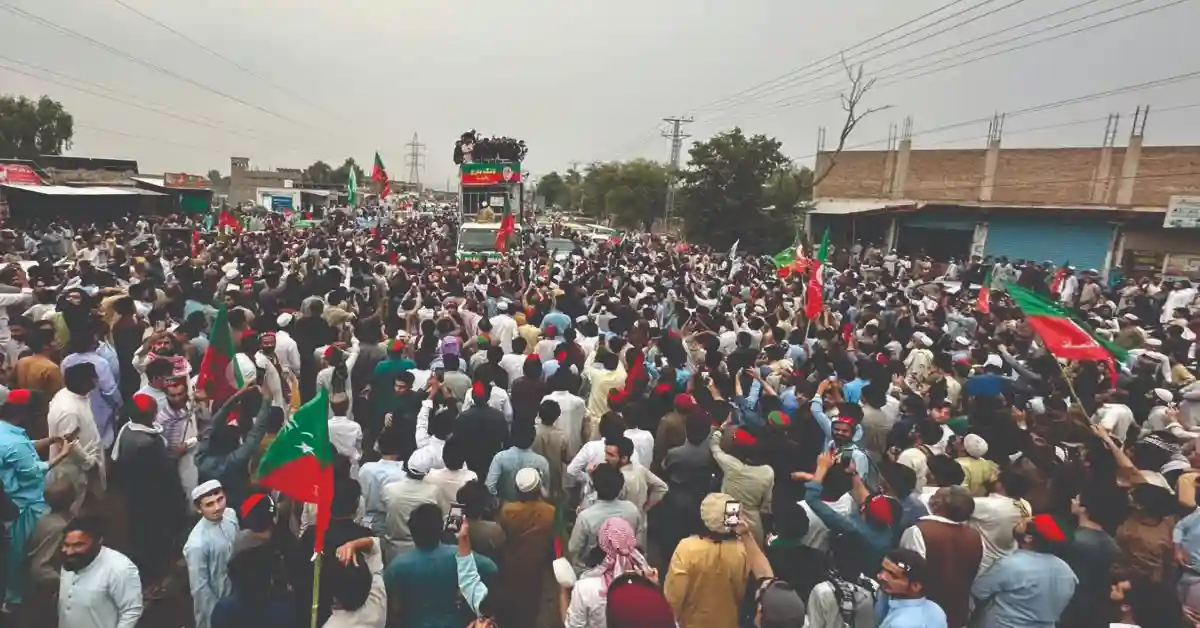
The PTI announced a long march to Islamabad on September 27, then deferred it to October 4, after a long session of talks with the federal government. The talks failed, and the march began on October 4. Government-side sources and Interior Minister Mohsin Naqvi have blamed Afridi, with Naqvi saying he changed the agreement. Sources cited by ARY News also named Achakzai as a key figure in the breakdown.
PTI gives a different account. Raja has said Afridi only asked for details of what the emergency would involve and sought consensus, and that the party wanted physicians to be allowed to examine Imran Khan. He also said the government was pushing PTI to back every counterterrorism action in K-P, and that any lasting settlement needed Imran Khan’s involvement.
The emergency and governor’s rule
On October 11, the federal government imposed an emergency and governor’s rule in K-P, with the emergency covering 12 districts, and Afridi’s government was dismissed. The Centre cited the provincial government’s alleged disengagement from the fight against terrorism. Deputy Prime Minister Ishaq Dar said terrorism incidents had doubled during Afridi’s tenure and defended the cabinet’s decision to end the reconciliation process. Parliament’s joint session endorsed the measures on October 15 amid opposition protests. Naqvi told the House the government had preferred talks until the last moment. Gohar rejected the claim that PTI backs terrorists.
JUI-F chief Maulana Fazlur Rehman has accused the government of backing out of negotiations after initially agreeing to demands, and rejected the emergency.
Latest developments
Gohar has said PTI has had no contact with Afridi since October 11, and that PTI is willing to hold unconditional talks. Responding to an offer from Pakistan Peoples Party chairman Bilawal Bhutto Zardari, he asked who had told the government’s committee to leave the negotiating table. Bilawal has said dialogue can end the K-P emergency.
Prime Minister’s Adviser Rana Sanaullah has said the government is willing to hold talks without preconditions but will not agree to withdraw the emergency measures. He has hinted that the governor’s rule could be reconsidered if PTI agrees to support counterterrorism efforts. The Peshawar High Court has fixed October 20 to hear a PTI petition against the governor’s rule and emergency.
Background
This is not the first time talks between PTI and the government have broken down. Negotiations began in December 2024 and ended in January 2025, when PTI boycotted a scheduled session over the government’s failure to commit to judicial commissions. Reports earlier this year also pointed to friction within the party, including between Gohar and Raja. Those accounts relied on unnamed party sources.