

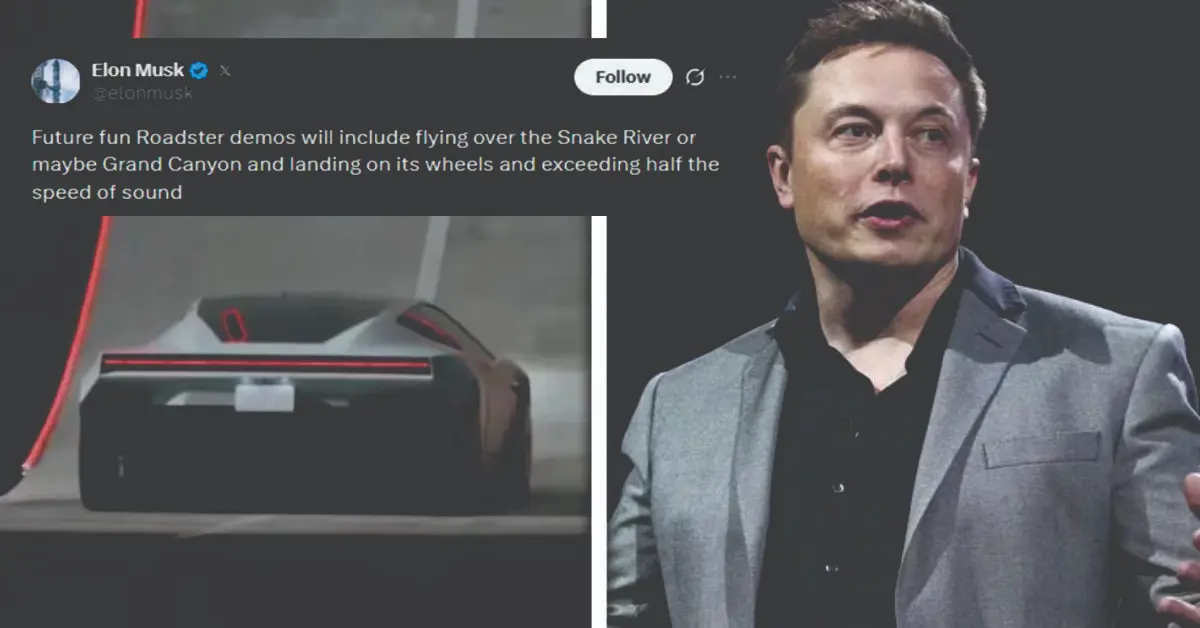
Austin, Texas: Elon Musk has floated an even bigger stunt for Tesla’s newly unveiled Roadster, saying future demonstrations could see it fly over a canyon at more than half the speed of sound and land safely on its wheels. The prediction follows a dramatic demonstration of the car’s rocket-style thrusters in Texas last week.
The prediction
In a post on X, Musk wrote that future fun Roadster demos will include flying over the Snake River or maybe the Grand Canyon, landing on its wheels and exceeding half the speed of sound. Half the speed of sound is roughly 380 miles per hour, far above the 230 miles per hour top speed Tesla currently lists for the car.
The unveiling
Tesla showed off the redesigned second-generation Roadster on Thursday, October 15, at SpaceX’s test facility in McGregor, Texas. The car was developed jointly by Tesla and SpaceX engineers. In demo footage, the prototype launched upside down off a half-circle ramp and guided itself through a corkscrew maneuver. In a second stunt, it jumped over a line of Tesla vehicles, again with a corkscrew.
Musk shared the footage on X, writing that the future does have flying cars. During the presentation, he said the car has attitude-control thrusters and main thrusters at the rear, so it can basically fly like a rocket and do rolls.
How it works
The Roadster uses SpaceX cold-gas thrusters, which release pressurised gas to produce thrust. Musk described an advanced ultra-high-pressure air tank feeding thrusters rated at more than 80 kilonewtons, using compressed air rather than rocket fuel. Unlike a conventional flying vehicle, the car has no wings for sustained flight. The thrusters provide short bursts of lift and maneuvering.
The demonstration took place well away from the stage for safety reasons, and the thrusters were deafeningly loud. In the demo, the car reached 60 mph in about one second on a first run and a claimed 0.8 seconds on a second, with the help of four rear thrusters. That figure reflects rocket assistance rather than what the electric motors alone can manage.
The Evel Knievel connection
Near the end of the livestream, Musk floated a follow-on demonstration inspired by Evel Knievel’s failed 1974 attempt to jump Idaho’s Snake River Canyon in a steam-powered rocket. Knievel’s parachute deployed prematurely and he fell into the canyon, though he survived. Musk said he did not know whether a similar jump was possible, but added, “Let’s give it another shot.”
Three versions
Tesla’s reservation page lists several trims. The Performance version, described as road ready, requires a $50,000 deposit. The Thrust version adds rear cold-gas thrusters for sub-one-second 0 to 60 acceleration and requires a $250,000 deposit. The top-tier Rocket version, described as air ready, is invite-only, seats one and has 10 thrusters positioned around the car. Musk said the car is intended to be the last of the human-driven Teslas, and production is targeted for 2028.
Caveats
The demonstration was staged in a controlled environment, and it does not show that the Roadster is ready to fly on public roads. Safety and legal approvals would be needed, and Musk himself acknowledged the flying feature may not be legal everywhere.
The thrusters provide brief aerial movements rather than continuous flight, so the recent demonstration should not be equated with sustained flight. Musk also described the canyon jump only as a possible future demo, not a scheduled event.
The Roadster also has a long record of delays. Tesla first showed it in 2017 with production planned for 2020, and Musk pushed the timeline back repeatedly in the years since. Even the latest demo slipped from earlier targets of April, then May or June, then August. Some critics remain skeptical of the 2028 date.